Get a quote today!
CALL 1300 947 471

5 STAR GOOGLE RATING
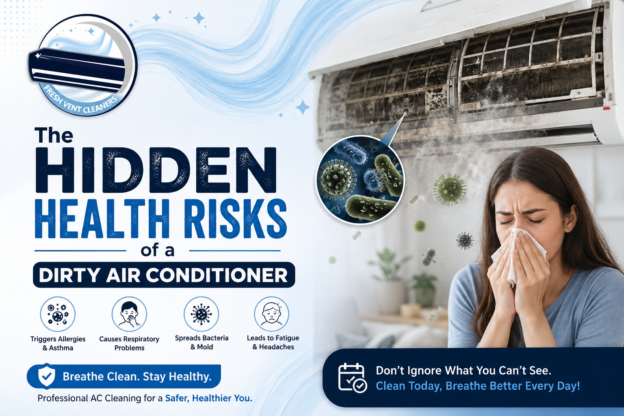
If you’ve been sneezing more at home, waking up with a headache, or noticing your allergies flare up the moment you switch your AC on, your air conditioner might be the reason — not the weather, not hay fever, not a cold you can’t shake. A dirty air conditioner doesn’t just cool your home poorly. It actively recirculates the exact particles that make you feel unwell, every single time it runs.
Here’s what’s actually happening inside your unit, and what you can do about it.
Yes — and it’s more common than most Melbourne homeowners realise. Your AC filter’s job is to trap dust, pollen, pet dander, and airborne bacteria before they circulate through your home. When that filter is clogged or hasn’t been cleaned in months, two things happen:
This is why so many people notice symptoms specifically when the AC is running, and feel better when they step outside or turn it off.
If you already have seasonal allergies, a dirty AC can make them significantly worse year-round. Split systems and ducted units both accumulate dust and pollen inside their coils and vents over time. Every cooling cycle stirs this buildup back into the air, effectively giving you an allergy trigger on demand — even in the middle of winter, long after pollen season outdoors has ended.
Common allergy symptoms linked to a dirty AC include:
Sinus pressure and congestion are two of the most frequently reported issues tied to poorly maintained air conditioners. Dust, mould spores, and bacteria trapped in the coils and ductwork irritate the sinus lining, leading to that familiar heavy, blocked-up feeling — especially in homes where the AC runs for extended periods, like during a Melbourne heatwave.
If your sinus issues seem to track with how long the AC has been running, that’s a strong signal the unit itself needs attention rather than your sinuses.
Headaches linked to air conditioning usually come from one of two sources: poor air circulation caused by blocked filters and coils, or mould and bacterial growth releasing airborne irritants (mycotoxins) into the room. Reduced airflow can also mean your AC is working harder and less efficiently, subtly affecting indoor air quality and temperature regulation in ways that contribute to tension headaches over a long day indoors.
Sudden sneezing fits when you walk into an air-conditioned room are a classic sign of dust and allergen buildup being blasted directly into the airflow. Unlike outdoor allergens that dilute in open air, particles from a dirty AC are concentrated and repeatedly recirculated in an enclosed space — which is why the reaction can feel more intense indoors than out.
Portable units carry an extra risk that split and ducted systems don’t: standing water. Most portable ACs collect condensation in an internal tank or tray, and if it isn’t emptied and cleaned regularly, that stagnant water becomes a breeding ground for mould and bacteria — which the unit then blows directly into your room. Portable AC owners should check and clean the water tank at least as often as they clean the filter, not just when it’s full.
All of this feeds into a bigger picture: indoor air quality. Melbourne homes and offices are sealed up for hours at a time during summer, and your air conditioner is effectively the lungs of that space — everything it recirculates, you’re breathing. A well-maintained AC actively improves the air in your home. A neglected one becomes one of the biggest sources of indoor air pollution most people never think to check.
If you’re noticing ongoing symptoms and want to understand exactly what’s circulating through your space, a professional indoor air quality assessment alongside a full AC clean can identify whether your unit is the source — rather than guessing.
The good news: none of this requires replacing your unit. A thorough professional clean addresses the coils, filters, drainage, and internal components that trap allergens, mould, and bacteria — the parts a quick filter wipe-down at home simply can’t reach.
At Fresh Vent Cleaners, we offer:
Whether your symptoms started recently or you’ve just been putting off maintenance, a professional clean is usually enough to notice a difference within days.
If your AC has gone more than 12 months without a professional clean — or you’ve started noticing allergies, headaches, sinus pressure, or sneezing that seem to track with when it’s running — it’s worth booking a clean before summer puts your unit under heavier use.
Book your AC cleaning service with Fresh Vent Cleaners today and breathe easier in your own home.